Solar System Sizes
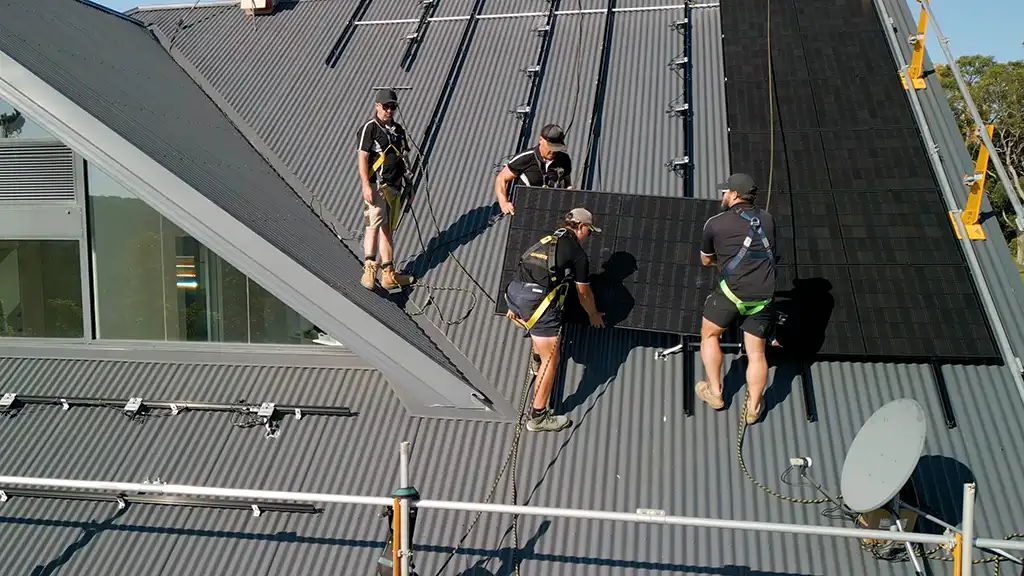
What Size Solar System Do You Need?
Three sizes cover almost every home we install around Penrith, Emu Plains and the Blue Mountains.
6.6kW is 15 panels on a 5kW inverter, making around 9,430 kWh a year here. 10kW is 23 panels on an 8kW inverter, around 14,287 kWh. 13kW is 30 panels on a 10kW inverter, around 18,574 kWh.
The quickest way to narrow it down is your bill. Find your daily average kWh, multiply by 365. Under about 7,000 kWh a year points to 6.6kW. Between 7,000 and 11,000 points to 10kW. Above that, 13kW.
That’s the shortcut. The rest of this page is the detail behind it, what each size actually produces here, how much roof it needs, and the two things that catch people out: the grid connection rules that start to bite at 10kW, and the fact that generating power isn’t the same as using it.
The Three Sizes at a Glance
6.6kW
THE STANDARD
15 panels · 5kW inverter · 30m² of roof
~26 kWh a day
Three to four bedrooms, gas hot water or cooking, no pool, no electric car.
10kW
THE MODERN DEFAULT
23 panels · 8kW inverter · 45m² of roof
~39 kWh a day
Pool, ducted air conditioning, an EV, or a battery in the plan.
13kW
THE ALL-ELECTRIC HOME
30 panels · 10kW inverter · 60m² of roof
~51 kWh a day
Off gas entirely, EV charging, large home, or a big battery.
6.6kW vs 10kW vs 13kW Compared
All output figures are for a north-facing, unshaded array around Penrith and the lower Blue Mountains, on a clear day.
| 6.6kW | 10kW | 13kW | |
|---|---|---|---|
| Panels (at 440W) | 15 | 23 | 30 |
| Inverter | 5kW | 8kW | 10kW |
| Roof space needed | about 30m² | about 45m² | about 60m² |
| Average day | about 26 kWh | about 39 kWh | about 51 kWh |
| Midsummer day | about 35 kWh | about 53 kWh | about 69 kWh |
| Midwinter day | about 17 kWh | about 25 kWh | about 33 kWh |
| Across a year | 9,430 kWh | 14,287 kWh | 18,574 kWh |
| Suits annual use of | under ~7,000 kWh | ~7,000–11,000 kWh | above ~11,000 kWh |
| Single-phase supply | Fine | Usually the ceiling — export limits apply | Three-phase usually needed |
| Grid connection | Straightforward | Export limit likely applied | Application and approval before install |
| Battery pairing | Tight in winter | Comfortable | Comfortable, larger batteries too |
| Typical install time | One day | One day | One to two days |
Which Size Is Yours?
Find your household. We’d rather you worked this out here than discovered it two years after the install.
| Your household | Size | Why |
|---|---|---|
| 2–4 people, 3 bedrooms, gas cooking or hot water, no pool, out most weekdays | 6.6kW | The household 6.6kW was designed around. Going bigger mostly means exporting more at a low rate. |
| Someone home during the day, or working from home | 6.6kW | You’ll self-consume far more of what you generate, which is where the real saving lives. |
| Whole-house ducted air conditioning | 10kW | On a 40°C Penrith afternoon a ducted system can absorb most of what a 6.6kW array is making. |
| Swimming pool | 10kW | A pool pump is a large, predictable daytime load — the clearest single reason to step up. |
| Electric vehicle, or one coming | 10kW+ | An EV can add several thousand kWh a year on its own. Sizing for the car you’ll buy is cheaper than resizing later. |
| Battery now or within a few years | 10kW+ | A battery has to be filled and the house run at the same time. In winter, 6.6kW often can’t do both. |
| Going all-electric, off gas entirely | 13kW | Electric hot water, induction cooking and reverse-cycle heating roughly double a household’s electricity use. |
| Large home, EV, pool and a battery together | 13kW | Stacked loads add up fast. This is where three-phase supply usually becomes part of the conversation. |
| Small roof, or heavy tree cover | Whatever fits | Common through the upper Mountains. The constraint is usable roof, and panel-level electronics matter more than size. |
The one number that settles it. Find the daily average kWh on your electricity bill and multiply by 365. That single figure narrows the choice faster than any calculator.
Why the Numbers Look Odd
Why 6.6kW and not 6 or 7? Why does a 6.6kW system have a 5kW inverter? This is the most-asked question we get, and the answer explains how every Australian system is sized.
Australian rules allow your panel capacity to exceed your inverter capacity by up to a third. A 5kW inverter can legally carry around 6.6kW of panels, an 8kW inverter around 10kW, a 10kW inverter around 13kW. That’s not a loophole — it’s deliberate, and it’s why the system sizes look like they do rather than being round numbers.
Panels almost never produce their rated output. A 440W panel is rated in a laboratory: full sun intensity, cell temperature 25°C. A roof in Penrith in February is nothing like that. Real output sits well below the rating for most of the day, so an inverter matched exactly to the panels would spend its life half-used.
Oversizing captures the mornings and afternoons. Adding a third more panel capacity lifts output through the shoulders of the day and across cloudy weather. For a few hours on bright summer days the inverter reaches its ceiling and clips the peak — that’s expected, and you gain far more across the year than you lose in those bursts.
So 15 × 440W panels = 6,600W on a 5kW inverter. That’s a 6.6kW system. Same logic gives you 23 panels on an 8kW inverter, and 30 panels on a 10kW inverter.
One thing worth knowing when comparing quotes. Older systems used 370W or 400W panels, so 6.6kW took 17 or 18 panels rather than 15. Panel counts vary between quotes for identical system sizes. Compare kilowatts, not panel counts — and check which figure a quote is describing, because “10kW” sometimes means the panels and sometimes the inverter.
Where the Grid Starts to Have an Opinion
This is the part almost no size comparison mentions, and it’s the reason stepping up isn’t automatic.
At 6.6kW, nothing gets in your way. A single-phase connection handles it and approval is routine.
At 10kW, export limits enter the picture. Endeavour Energy caps how much you can push back into the network, and those limits depend on your connection type and where you are. On a single-phase supply, a 10kW system will often be export-limited — meaning it generates the full amount, but anything above the cap that you aren’t using at that moment is curtailed rather than exported. That doesn’t make the system pointless, but it does change the maths, and it strengthens the case for a battery or for shifting loads into daylight.
At 13kW, three-phase supply usually becomes necessary, and the connection generally requires an application and approval before installation rather than routine sign-off. If your home is single-phase, upgrading the supply is a separate job with its own lead time — and it’s much better established before the panels are ordered than after.
Check your switchboard early. Homes built before the 1990s frequently need switchboard work to accommodate a modern system safely, and larger systems make that more likely. It’s the most common surprise on a solar job and it’s entirely avoidable with a proper site assessment.
Current export limits and connection rules change, so we confirm your specific situation with Endeavour before designing anything.

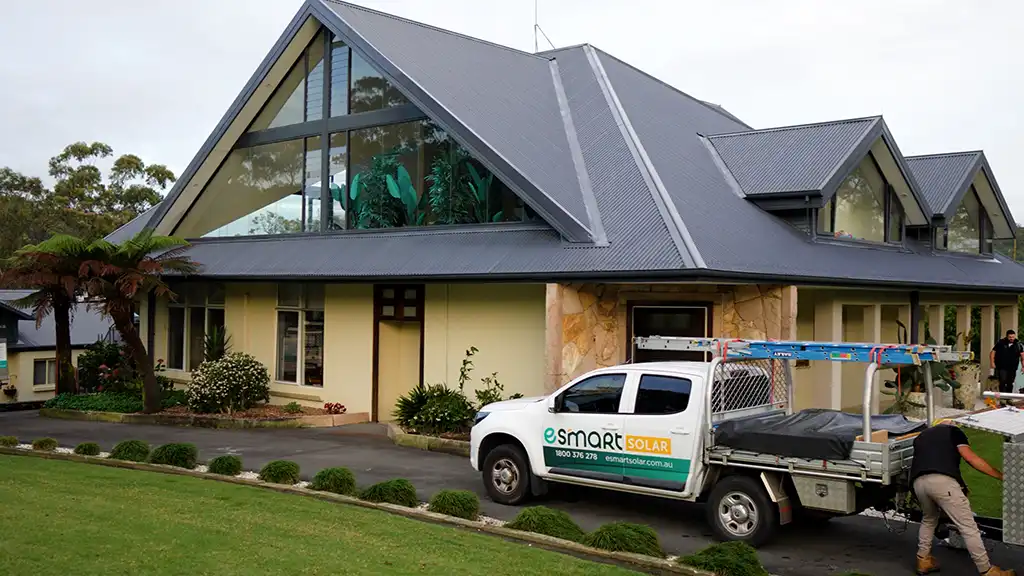

Sizing on a Mountains Roof
The same system behaves differently in Glenmore Park than it does in Hazelbrook, and up the line the size question often isn’t the important one.
Roof space is the first constraint. Thirty panels need around 60m² of unshaded, unobstructed roof — before you allow for vents, aerials, skylights and required edge setbacks. On the older cottages common through the Mountains, with split levels, dormers and skillion additions, fitting even fifteen panels on one clean plane often isn’t possible. Splitting an array across two or three orientations is normal and works fine.
Shade changes the answer entirely. Under established eucalypt canopy, a string inverter performs close to its weakest panel, so a large array can underperform a smaller, better-designed one. On those roofs the conversation should be about micro inverters or optimisers before it’s about kilowatts. A well-designed 6.6kW system with panel-level electronics will beat a poorly-designed 10kW one under trees.
Canopy grows. A roof that’s clear today can be materially shaded within five to ten years. We model where the shade will be in a decade, not just this afternoon.
Bushfire zones affect the install. Properties in designated bushfire-prone areas carry BAL requirements that influence equipment and installation detail. Worth raising at quote stage rather than on install day.
We install across more than 50 suburbs from Emu Plains and Penrith up through Springwood, Katoomba and Blackheath.
When We Tell People to Go Smaller
Bigger isn’t automatically better. These are the three situations where we’ll steer you down a size.
You'd Export Most of It
Empty house all week, low daytime use, no plans to shift loads or add storage? A smaller system you actually consume serves you better than a bigger one feeding the grid at feed-in rates.
The Roof Won't Take It
Heavy canopy or a small, broken-up roof means the extra panels have nowhere useful to go. We’ll say so at the assessment rather than cramming panels into positions that never produce.
The Grid Would Curtail It
If a tight export limit applies at your address and you’ve no plans for a battery or daytime load shifting, the top end of a larger system may simply be curtailed. Better to know first.
Solar System Size Questions
What size solar system do I need?
How many panels are in a 6.6kW, 10kW or 13kW system?
How much roof space does each size need?
How much power does each size produce per day?
Why does a 6.6kW system have a 5kW inverter?
Do I need three-phase power for a 10kW or 13kW system?
Is a bigger solar system always better?
What size solar system do I need for a battery?
Can I start smaller and add panels later?
How long does installation take?
How do I know my system is producing what it should?
Get It Sized Properly
Send us a recent bill and a photo of your roof. We’ll tell you which size actually fits your household — including when that’s smaller than you expected. We design from your bills and your roof, not from a package list.
Or call 02 4703 5411 — you’ll get one of our own electricians, not a call centre.