Microinverters
Do You Actually Need Microinverters?
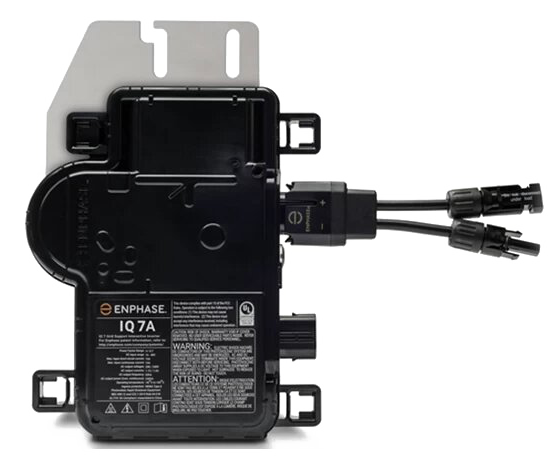
A microinverter converts DC to AC at each individual solar panel, instead of at one central box on your wall. That means a shaded, dirty or faulty panel can’t drag down the rest of the array. In Australia, Enphase microinverters cost roughly $150 to $300 per panel, about $1,500 to $3,000 more than a string inverter on a typical home system.
They’re worth that premium on shaded, multi-directional or complex roofs, which describes most of the Blue Mountains. On a clean, unshaded, north-facing roof they usually aren’t — and we’ll tell you that rather than sell you one.
We’ve fitted both architectures across Emu Plains, Penrith, the Blue Mountains and Western Sydney since 2014. This page is the advice we give at the kitchen table, including the part where we talk people out of spending the extra money.
Microinverters by the Numbers
$150-$300
PER PANEL, INSTALLED
$1,500-$3,000
TYPICAL PREMIUM OVER STRING
10-25%
EXTRA OUTPUT ON A SHADED ROOF
25 YEARS
ENPHASE IQ8 WARRANTY IN AUSTRALIA
What a Microinverter Actually Does
Your inverter is the part that turns the direct current your panels make into the alternating current your house runs on. A string inverter does that for the whole array at once, from a single box on your wall.
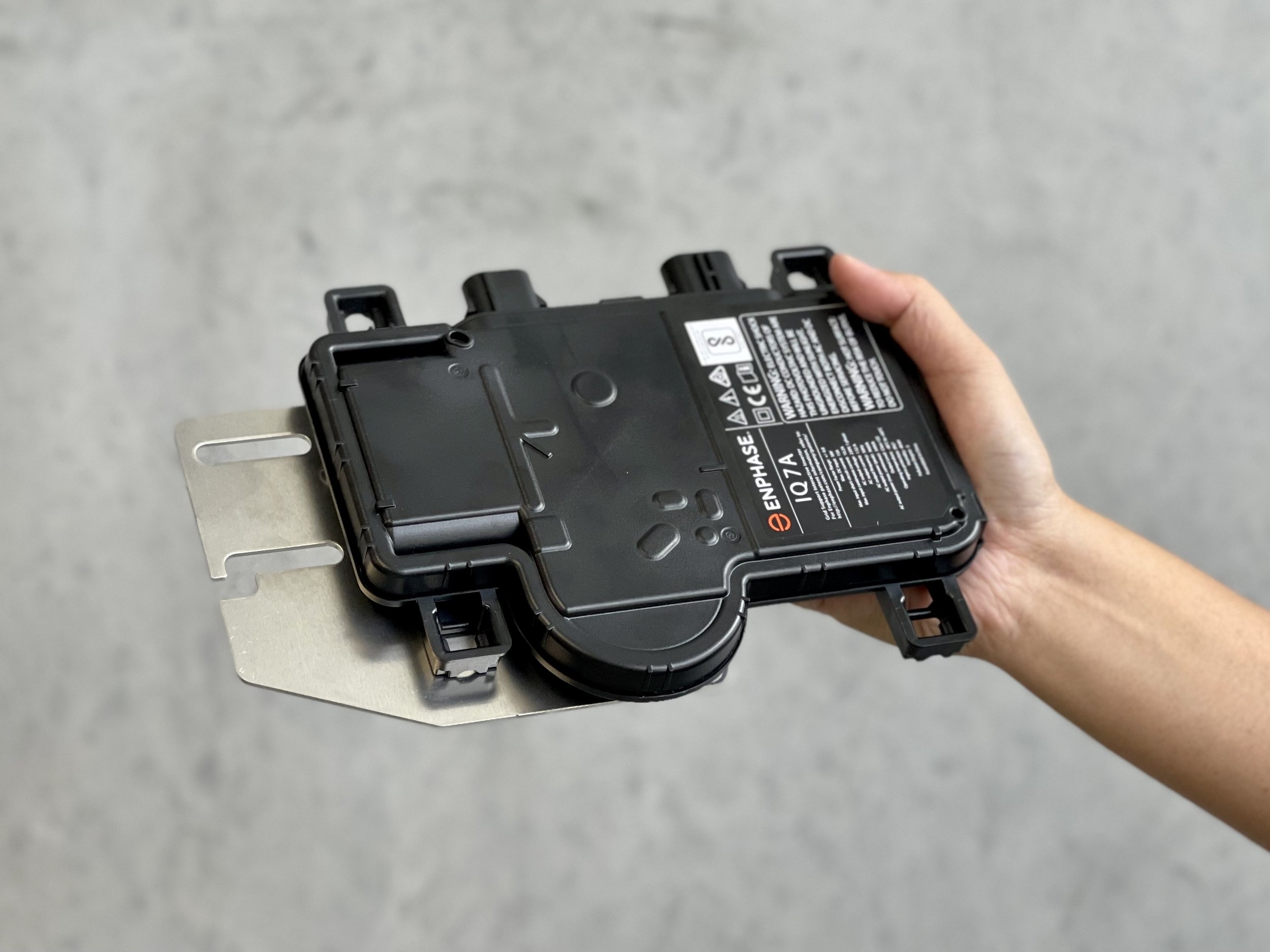
A microinverter does it for one panel, mounted on the racking underneath it. The practical difference is independence. A string treats a row of panels as one large panel, so the whole string performs close to its weakest member. Shade from a chimney, a bird mess, a branch, a power line — any of it drags down every panel wired with it, not just the one affected.
With microinverters, that panel drops and the rest carry on. It’s the same reason your house doesn’t go dark when one light bulb blows.
Microinverters vs String Inverters vs Power Optimisers
There are three ways to wire a residential solar array in Australia. Installers who only sell one of them will tell you it’s the best one. Here’s the honest comparison.
| String inverter | String + power optimisers | Micro inverters | |
|---|---|---|---|
| Typical brand | Fronius, Sungrow, GoodWe | SolarEdge | Enphase IQ8 |
| Where DC becomes AC | One central unit on your wall | Centrally, after each panel is optimised in DC | Under each individual panel |
| Shade tolerance | Poor — a string performs close to its weakest panel | Good | Best — each panel is independent |
| Typical cost, 6.6kW system | $1,000-$2,500 installed | Roughly $1,500-$2,500 more than string | $150-$250 per panel, so $2,250-$3,750 in units |
| Standard warranty in Australia | 10-12 years | 12 years inverter, 25 years optimisers | 25 years on IQ8, activated from Oct 2024 |
| Mid-life replacement | Likely — budget $1,500-$2,500 around year 12 | Inverter likely, optimisers no | No |
| Peak conversion efficiency | Up to 99% | Up to 99% | About 97% |
| Panel-level monitoring | No — array total only | Yes | Yes |
| If one unit fails | Whole system stops | Whole system stops if the inverter fails | You lose one panel |
| Repair access | Ground level | Ground level for the inverter, roof for an optimiser | Roof access needed |
| Adding panels later | Constrained by inverter capacity and string matching | Some flexibility | Add freely, one microinverter per panel |
| DC voltage on the roof | High-voltage DC across the roof space | Reduced, with rapid shutdown | None — it’s AC at the panel |
| Best suited to | Simple, open, single-orientation roofs | Shaded roofs where ground-level servicing matters | Shaded or complex roofs, staged expansion, set and forget |
Prices are typical installed Australian ranges as at 2026 and vary with system size, roof type and brand.
The trade-off nobody mentions: microinverters win on shade and lose on access. A string inverter that fails is replaced from a ladder in an hour. A microinverter that fails means panels come off the roof. Enphase quotes an annual failure rate around 0.05%, so it’s rare — but on a steep two-storey tile roof it’s a genuine reason to look at power optimisers instead.
Which One Suits Your Roof?
The same answer we’d give you standing in your driveway.
A String Inverter
Your roof is open, north facing and single plane, with nothing shading it. Micro inverters would cost around $2,000 more and produce about the same. Spend the difference on two extra panels instead — you’ll be materially better off.
Power Optimisers
Your roof is shaded, but it’s two storeys, steep or tiled. You get most of the panel-level benefit while keeping the part most likely to need attention down at ground level, not up a ladder on a wet Tuesday.
Microinverters
Trees or a neighbour’s roof shade part of the array, panels face three or more directions, or you plan to expand in stages. Shade plus multiple orientations is the clearest case there is for going panel by panel.

When We Talk People Out of Them
We install Enphase and we rate it. We still don’t recommend it for every roof, and these are the five times we say no.
- Your roof is clean and north facing. You’d be paying $2,000 for a shade solution to a problem you don’t have.
- You’re installing a Powerwall 3 or another DC-coupled battery. It has a solar inverter built in, so you’d be paying for inverter capacity twice. There are exceptions — a badly shaded roof, or retrofitting to an existing microinverter array — but it should be a deliberate call.
- The roof is steep, tiled and two storeys up. Every future service call means scaffolding or a roof anchor. Optimisers give you most of the benefit with easier access.
- The budget is genuinely tight. If the premium is the difference between going solar this year and not, take the string inverter. A working system today beats a perfect one you never bought.
- You want maximum output on a clean roof. Micro inverters convert at around 97% against up to 99% for a good string inverter. Small, but real — and the opposite of what most microinverter marketing implies.
Why Shade Works Differently in the Blue Mountains
Most microinverter advice online is written for flat suburbs with clear roofs and a chimney. The Mountains isn’t that, and the difference changes the answer.
Tree shade moves, and it grows. A chimney casts the same shadow every year. A mature eucalypt doesn’t. Canopy shading shifts substantially between the summer and winter sun angles, and a roof that’s clear today can be materially shaded within five to ten years. When we assess a roof in Winmalee or Hazelbrook we’re working out where the shade will be in 2035, not just this afternoon. Panel-level electronics protect you against a roof that changes. A string inverter locks in today’s assumption.
Ridgelines and valleys shorten the solar day. Homes on the southern side of a ridge, or down in the valleys, lose generation at both ends of the day to terrain rather than anything on the roof. That compresses production into the middle of the day and makes every shaded hour count for more.
Older Mountains homes have complicated roofs. Split levels, additions, dormers, skillion extensions off weatherboard cottages. Multiple orientations is the second strongest argument for going panel by panel, after shade itself.
Bushfire zones change what goes on the roof. Properties in designated bushfire-prone areas carry BAL requirements affecting rooftop equipment and installation detail. Worth raising at quote stage rather than discovering on install day.
The cold is on your side. Electronics last longer at lower ambient temperatures, and the upper Mountains runs several degrees cooler than the Cumberland Plain. If you’re storing energy too, our guide to keeping solar batteries working through a Mountains winter covers the other half of that story.

Microinverter Questions We Get Asked
How much do microinverters cost in Australia?
Around $150 to $250 per microinverter, and you need one per panel. On a 6.6kW system of about 15 panels that’s $2,250 to $3,750 for the units, against $1,000 to $2,500 for a good string inverter. The net premium on a typical home system is roughly $1,500 to $3,000. The gap narrows over 25 years, because a string inverter usually needs replacing once at $1,500 to $2,500 and the Enphase IQ8 warranty runs the full term.
Do I need microinverters if my roof is shaded?
If the shade is unavoidable, you need either microinverters or power optimisers — a plain string inverter will cost you output, because the string performs close to its weakest panel. Which of the two comes down to roof access. Easy single storey, microinverters. Steep two storey tile, optimisers are often the better call because the serviceable part stays at ground level.
Enphase or SolarEdge, which is better?
Neither is better in the abstract; they solve the same problem differently. Enphase converts to AC at each panel, so a failure affects only that panel and there’s no high-voltage DC on the roof, but repairs need roof access. SolarEdge optimises each panel in DC and converts centrally, keeping a serviceable ground-level inverter and slightly higher peak efficiency, but that inverter is still a single point of failure. On an easy-access roof we usually lean Enphase. On a difficult one, SolarEdge.
What happens if a microinverter fails?
You lose the output of that one panel while the rest of the system keeps running, and the monitoring tells us exactly which unit it is. Replacement needs roof access, so it’s a bigger job than swapping a string inverter — but Enphase puts the annual failure rate at about 0.05%, and units activated since October 2024 carry a 25 year warranty.
Do microinverters work with a battery?
Yes, but the pairing matters. AC-coupled batteries work with a microinverter array without difficulty. A DC-coupled battery with a built-in hybrid inverter, like a Tesla Powerwall 3, duplicates inverter capacity you’ve already paid for. If a battery is part of your plan, decide the inverter architecture and the battery together rather than one after the other. Our battery storage page covers the pairing side of it.
Can I add microinverters to my existing solar system?
You can add a microinverter array alongside an existing string system, which is a common way to expand without touching what already works. Retrofitting microinverters onto panels currently running on a string inverter is possible but rarely economic on its own, unless that string inverter is failing anyway and you were facing a replacement.
Are microinverters worth it on an unshaded roof?
Usually not, for output. On a clean single-orientation roof they’ll produce roughly the same as a string inverter, and slightly less at peak given the efficiency difference. The remaining arguments are the 25 year warranty, panel-level monitoring and easy expansion — all real, but you should be buying those knowingly rather than believing you’re buying more electricity.
Not Sure Which Your Roof Needs?
Send us a photo of your roof and a recent bill. We’ll model your system both ways, string and microinverter, and show you the difference in output and cost before you commit to anything.