Commercial Solar Rebate in Penrith & the Blue Mountains: Now Up to 1MW
The federal solar rebate used to stop at 100kW. Since 1 October 2026 it covers systems up to 1MW. Here’s what that’s worth to a Western Sydney or Blue Mountains business, and what to check before you sign.
What Actually Changed
Until 30 September 2026, the Small-scale Renewable Energy Scheme (SRES) only supported solar up to 100kW. If your roof could take 150kW, 400kW or 800kW, you got nothing upfront.
From 1 October 2026, eligible systems from 100kW up to 1MW can create small-scale technology certificates (STCs), the same mechanism homes have used for years. The Australian Government estimates it cuts the upfront cost of a mid-sized commercial system by around 20%.
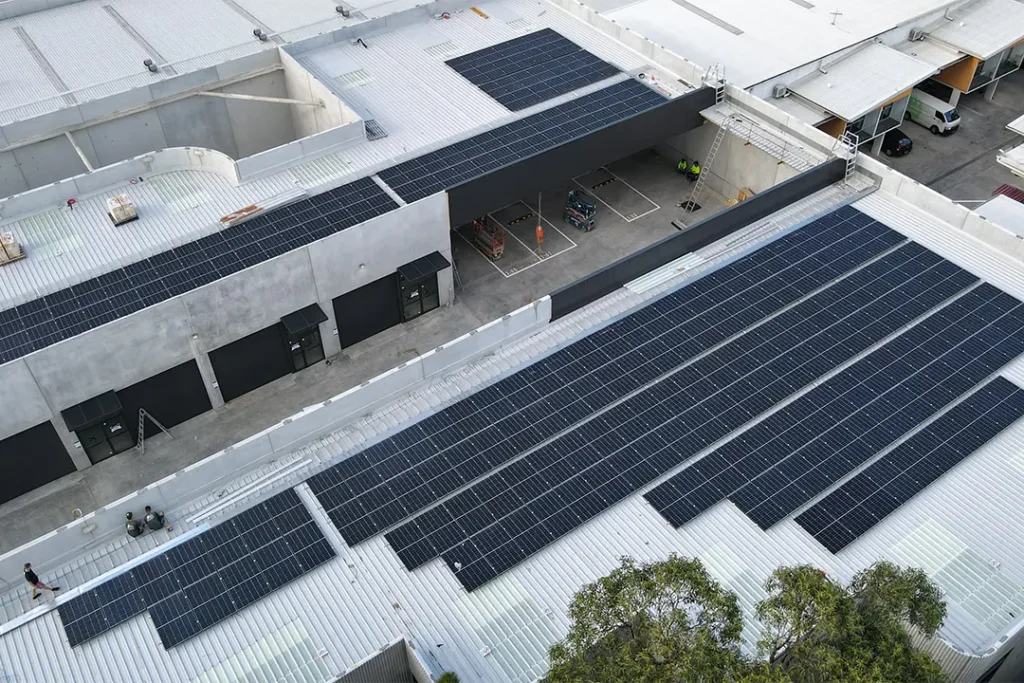
It suits the roofs we see all over this region: warehouses and workshops in Penrith, St Marys and Erskine Park, farm sheds in the Hawkesbury, schools, clubs and larger commercial buildings up the Mountains.
It isn’t a cash grant. STCs are tradeable certificates. Your installer normally takes them and deducts their value from your invoice.

The Dates That Matter
| When | What happens |
|---|---|
| 5 August 2026 | Minister Chris Bowen announces the expansion. |
| 1 October 2026 | Regulations in force. Eligible systems installed from this date can create STCs. |
| Mid to late November 2026 | The Clean Energy Regulator (CER) opens STC applications for mid-scale systems. Assessment starts after that. |
| Within 12 months of install | Window to create STCs for an eligible system. |
| 31 December 2030 | The SRES is scheduled to end. |
The gap between install and the November opening only affects when you can apply. The CER has confirmed it doesn’t reduce what an eligible system earns. Source: Clean Energy Regulator, mid-scale solar. Adding storage too? See the NSW battery incentives and the federal battery rebate.
What Your Roof Could Earn
The number of certificates is set by a formula: system size (kW) x zone rating x deeming years.
Every postcode we serve, including Penrith, Emu Plains, the Hawkesbury, Springwood, Katoomba and Lithgow, sits in STC Zone 3 (rating 1.382). Mid-scale systems get a fixed five years. That’s about 6.9 certificates for every kW, or roughly $260 to $275 per kW at current market prices.
Not sure what your roof produces? Try our solar output calculator.
Estimate only. Uses a certificate price of $38 to $40, before GST. STCs trade on the market and the CER sets the final number at assessment.
| System size | Typical building | STCs (Zone 3) | Indicative value |
|---|---|---|---|
| 120kW | Workshop, small warehouse | 829 | $31,500 to $33,200 |
| 250kW | Mid-size factory or logistics building | 1,727 | $65,600 to $69,100 |
| 500kW | Large warehouse or distribution centre | 3,455 | $131,300 to $138,200 |
| 850kW | Factory or large retail complex | 5,873 | $223,200 to $234,900 |
For comparison, the Minister’s own examples were about $68,000 on a 250kW system and about $232,000 on 850kW. The CER also publishes a mid-scale STC calculator if you want to check our maths.
Who Qualifies
The rebate is an extension of the existing SRES, so the existing rules still apply. For a mid-scale system, the CER expects:
- Capacity above 100kW and up to 1MW
- Installed on or after 1 October 2026. That’s the commissioning date on your certificate of electrical compliance, not your contract date
- Panels, inverters or batteries on the Clean Energy Council approved list (batteries have their own rules, see our federal battery rebate guide)
- An accredited installer, who must be on site for final commissioning and photograph it
- Evidence that planning, building and network approvals are in place
Already mid-build? Eligibility turns on the install date, not when you signed or ordered. A project that’s commissioned after 1 October can still qualify.
Three Rules That Catch People Out
STCs or REGO, not both
Systems from 100kW to 1MW can choose the upfront STC discount or create Renewable Electricity Guarantee of Origin (REGO) certificates. Claim STCs and you can’t create REGO certificates for the deeming period.
Extensions only earn on new capacity
Add 40kW to an existing 80kW system and the combined 120kW can qualify as mid-scale, but certificates apply to the extra 40kW only. The new and existing parts must be electrically connected as one system.
Other solar counts toward 1MW
The CER looks at related systems on the same or adjoining sites, including accredited large-scale power stations. Staged builds and multiple buildings need planning up front.
What's Different Up Here
The rebate is the easy part. On a commercial roof, the schedule is usually decided by approvals, so here’s what we plan around in Penrith, the Hawkesbury and the Blue Mountains.
Network approval comes first
Anything above the micro-generator size goes through your network’s embedded generator process, which for most of Penrith and the Blue Mountains is Endeavour Energy. Endeavour says systems up to 1MW can often connect at low voltage with minimal technical analysis, but approval is separate and the CER wants proof of it.
Roofs and switchboards
Older industrial buildings often need a structural engineer’s report and a switchboard upgrade before panels go on. The CER lists structural reports among the records you should keep, so we raise this at quote stage rather than on install day.
Bushfire-prone sites
Much of the Blue Mountains, Hawkesbury and Lithgow area carries bushfire attack level (BAL) requirements that affect where equipment and cabling can go. Better settled in the design than discovered at inspection. See our Katoomba and Lithgow pages for local detail.
Daytime load is the point
Cooling, refrigeration and machinery that run in daylight use solar directly. Penrith’s hot summers make that a strong fit. Evening or backup needs are a battery conversation, and our federal battery rebate guide, battery size calculator and blackout protection page cover that side.
Timing is the other local factor. Industry commentary suggests projects approaching 1MW can take around six months from early planning to completion, so it pays to start the design and approvals now. Pairing solar with a battery in the Mountains? Read how to keep batteries working in the cold. Local pages: Penrith, Emu Plains, Springwood, Katoomba and Lithgow.
Already Have a Commercial Solar Quote? Audit It.
With a new rebate comes a lot of loose “20% off” marketing. Here’s how to tell a worked-out quote from a guessed one, including if it came from us.
Signs it was worked out
- It shows the STC count, the price assumed per certificate and the net price after STCs
- It states system size in kW and how the 1MW limit applies to your whole site, including existing solar
- It lists the approvals needed (network, planning, structural) and who handles each
- It’s sized from a year of bills or interval data, not a rule of thumb
- It explains the STC versus REGO choice
- It names CEC-listed components and an accredited installer
- It gives a realistic commissioning date, with the 1 October cut-off in mind
Signs it was guessed
- A headline “20% off” with no certificate maths behind it
- No STC price stated, or the $40 maximum assumed when the market trades a little below it
- Existing solar on site ignored when counting toward 1MW
- No word on network approval or how long it takes
- The rebate treated as guaranteed cash on a fixed date
- Pressure about a rebate “ending soon” when mid-scale has a fixed rate to 2030
- A system sized to the roof rather than to your daytime load